

TL;DR
- A video that you can view or download is not automatically an asset you can publish in your Shopee affiliate content.
- Separate your original footage, specifically authorized assets, and references whose reuse permission is unknown.
- Permission to use a file and compliance with a platform's originality rules are separate checks.
- Ask about the exact video, channels, edits, duration, paid use, and third-party elements before relying on a seller's permission.
- Use reference notes to develop your own demonstration. Do not present someone else's product experience as your own.
Shopee affiliate videos should be built from material you are entitled to use and claims you can support. When you find an impressive product clip, decide whether it is something to study or an asset you have permission to publish. Keep that decision visible before opening your editing project.
This cross-market guide offers an editorial asset-planning method. Specific Shopee programs and publishing platforms have their own rules. The official examples below were checked on November 13, 2026 and are identified by country so you can verify the guidance that applies to your account.
Start with three asset categories
Avoid a single folder called “affiliate videos.” It hides the difference between a visual idea and a usable production file.
| Category | What to record | What still needs attention |
|---|---|---|
| Your original footage | Raw file, product identity, filming date, and what you demonstrated | Other material in the frame or soundtrack; platform requirements |
| Specifically authorized asset | Exact file and written scope of permission | Whether the person granting permission controls the relevant rights |
| Reference with unknown permission | Original URL and a note about the creative technique | Keep it out of the publishing project until its use is cleared |
These categories are a working filing method. A label you assign does not establish legal rights or platform approval.
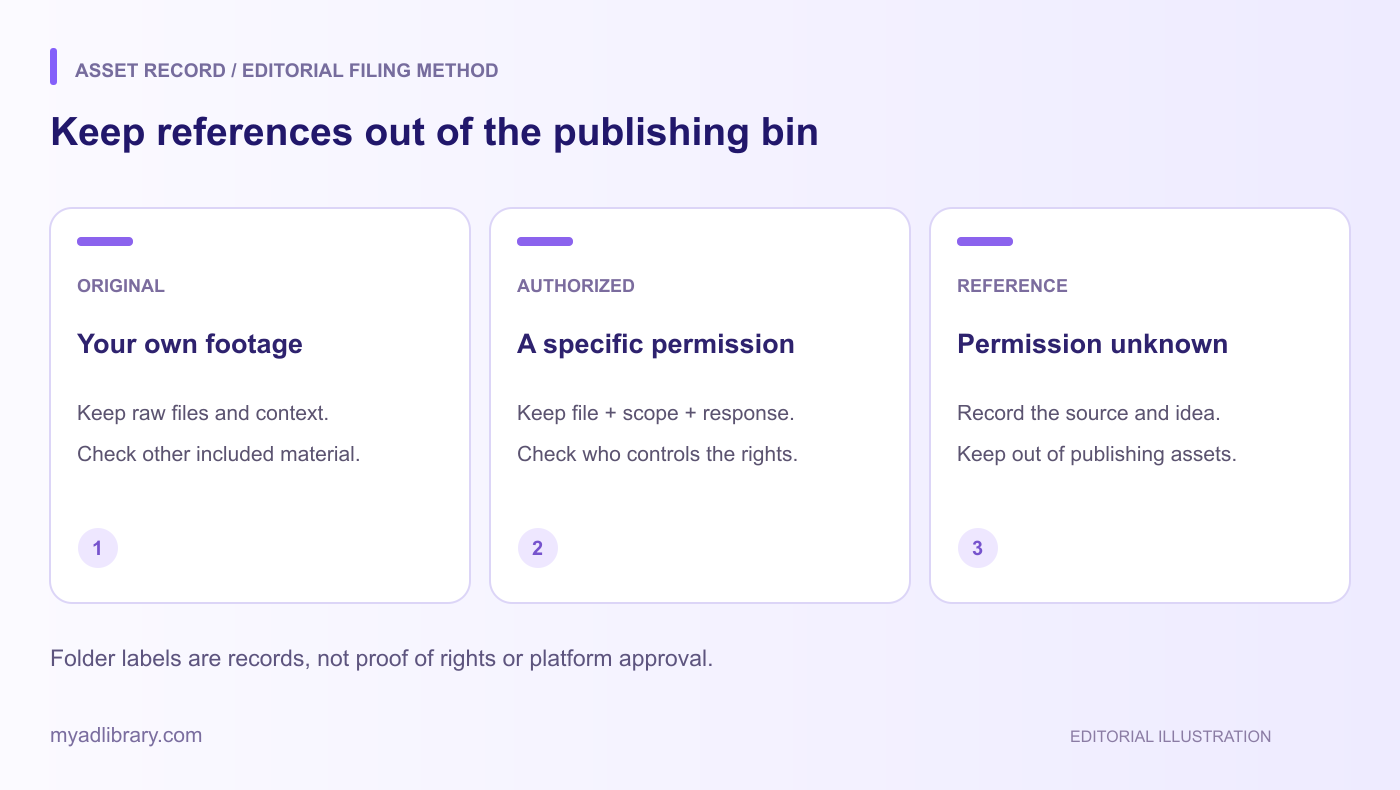
Editorial asset-planning diagram. Categories describe records to maintain, not a legal clearance or platform approval.
Can you use a seller's product video?
Do not assume that a listing makes its video available for your own promotion. Ask for the exact file and intended-use permission through an appropriate authorized route. Check the applicable program conditions as well as the asset permission.
For example, the Philippine affiliate terms address necessary rights for third-party material and prohibit certain automated scraping or extraction of Shopee intellectual property. Treat those as constraints on the workflow, not something a downloader can override.
A useful permission request identifies what you actually plan to do. “Can I use your video?” can leave important details unresolved.
| Request field | Example question |
|---|---|
| Exact asset | Does permission cover this specific file or version? |
| Publishing channel | May I use it on my named account and intended platform? |
| Editing | May I crop it, add narration, translate captions, or combine it with my footage? |
| Promotion type | Does permission include organic affiliate posts, paid promotion, or both? |
| Time and territory | Is there an expiry date or market restriction? |
| Included material | Are the music, voice, people, and other third-party elements also cleared? |
Save the response with the file, the date, and the person or organization that supplied it. If the scope remains uncertain, film your own demonstration or request a different asset.
Permission and originality answer different questions
Permission asks whether a proposed use is authorized. Originality rules ask whether the content meets the publishing program's standards. Passing one check does not automatically satisfy the other.
Shopee Brazil's originality guidance for Shopee Video explicitly distinguishes authorization from original authorship. It recommends creators' own contributions and discourages third-party packs and repetitive variations. This is a Brazilian policy example, not proof that every market uses identical wording or enforcement.
For an Indonesian example, the individual Shopee Video Creator terms say creators may be asked for documentation of permissions involving third-party intellectual property. That is a specific creator program; it should not be treated as the complete eligibility policy for all Indonesian affiliates.
The practical implication is to check both the asset record and the rules of the exact placement. An authorized seller clip can still be the wrong choice for a program that expects your own creative contribution.
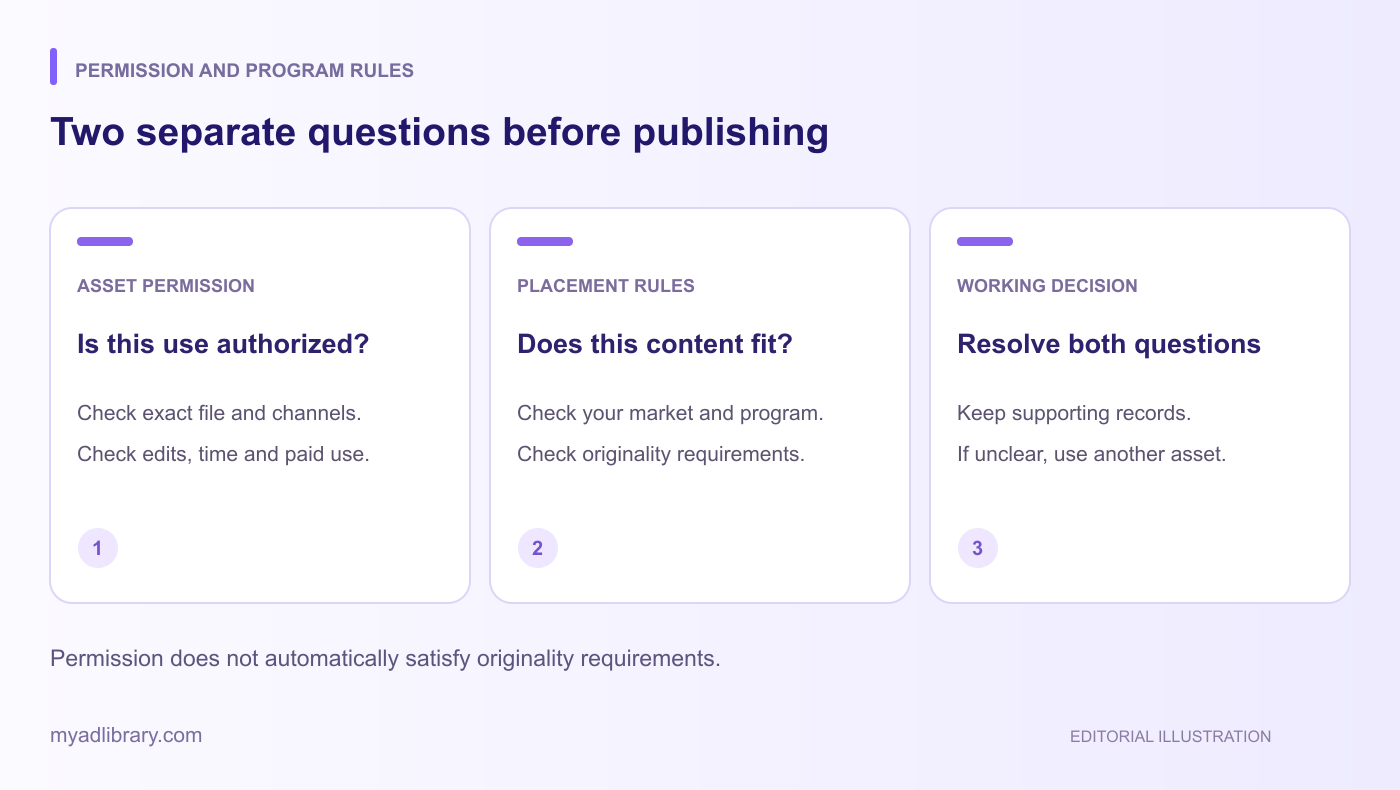
Editorial decision aid. Both questions need an answer; neither box certifies that a video is approved.
Study a reference without copying the finished video
Instead of saving “a video to repost,” save a precise observation about how the clip explains the product.
For a storage bag, the observation might be: “The creator places familiar objects inside before showing the outside dimensions.” You can develop a different demonstration with your own product, setting, sequence, and explanation. Avoid copying the script, distinctive visual execution, or another creator's personal story.
| Reference observation | New question to investigate | Your own evidence to collect |
|---|---|---|
| The clip shows the inside compartment | Will my usual items fit? | Film your actual items and the closure |
| A hinge is visible in close-up | How does the hinge move? | Record the mechanism on your own item |
| The product sits beside a laptop | How much usable desk space remains? | Measure your actual desk arrangement |
These are fictional planning examples. They do not establish the performance of any particular product.
Where MyAdLibrary fits
MyAdLibrary can support creative-reference research, while your asset record tracks what you are permitted to collect and publish. The Shopee Video Downloader currently shows free-to-try public access without an account requirement. That is a tool-access statement, not a content license or authorization to bypass Shopee's terms.
If collection is allowed for your intended source and use, the existing Shopee product-media guide covers the file-selection workflow. This article makes no claim that a particular source was downloaded or cleared for reuse. Prefer seller-supplied files through an authorized route when program restrictions rule out extraction.
Keep the source URL, product identity, observation, collection conditions, and permission record together. Store files with unknown permission outside the folder your editor uses for publishing assets.
Write claims to match the evidence
Even your own footage can support only what it shows. A new clip of a container closing demonstrates that particular closure under those conditions. It does not establish long-term durability, leak resistance in every situation, or a customer's future experience.
Use three labels in your brief:
- Observed: something you actually measured, filmed, or experienced.
- Seller-stated: a listing detail that you attribute and have not independently tested.
- Untested: an idea you must verify or omit before publishing.
Write your narration from those labels. If you only read the listing, use wording such as “the seller lists these dimensions.” If you measured the item, state what and how you measured. Do not narrate an unboxing or week-long review you did not perform.
For practical starting formats, use our Indonesia content-idea guide, while checking your own market's rules. Its prompts focus on visible buyer questions rather than borrowed testimonials.
Common questions
Does adding credit make a seller video usable?
Do not use credit as a substitute for permission. Keep attribution, asset authorization, and placement rules as separate fields in the brief.
Does changing the music or cropping the frame make a video original?
Do not rely on small edits as proof of originality or permission. Plan a contribution you can identify, then check the relevant publishing requirements.
What should I do when permission is unclear?
Leave the file out of the publishing project. Keep the source note if your research use is permitted, ask for clarification, or create your own demonstration. That gives your Shopee affiliate videos a clearer foundation than treating every downloadable clip as ready to post.