

TL;DR
- A Shopee product link identifies a listing. A Shopee affiliate link is produced through an affiliate workflow for program attribution.
- Do not assume that a normal share URL, a short URL, or a link that opens the right product carries your affiliate attribution.
- Save three records: the product source, the approved affiliate link, and the published content URL.
- Use the tools and guidance for your market. Link formats, supported placements, and offer conditions can differ.
- A correct destination, recorded click, qualifying order, and payable commission are different observations.
The key difference in Shopee affiliate link vs product link is purpose: one helps identify a product; the other participates in affiliate tracking under a program's rules. Both can lead to the same listing, which is why a working product page alone does not tell you whether your content has the correct affiliate link.
Keep both records. The source helps you research and verify the item, while the affiliate link belongs with the post you intend to publish. This is a cross-market planning guide, not a walkthrough of one account's link-generation screens. Official examples were checked on November 13, 2026.
What each link is for
| Record | Main job | What it does not establish |
|---|---|---|
| Product source URL | Find the listing, seller, product identity, and available details | That the URL attributes purchases to your affiliate account |
| Affiliate URL from your approved workflow | Connect the promotion to the affiliate program's attribution process | That every click or order earns commission |
| Published content URL | Find the post containing the recommendation | Which product variant or offer the post originally described |
Shopee Malaysia's official link-sharing guide documents sharing through its affiliate area and generating custom affiliate links. It also describes SubIDs for distinguishing placements. Those are Malaysian examples; they do not establish identical menu names or tracking options for every country.
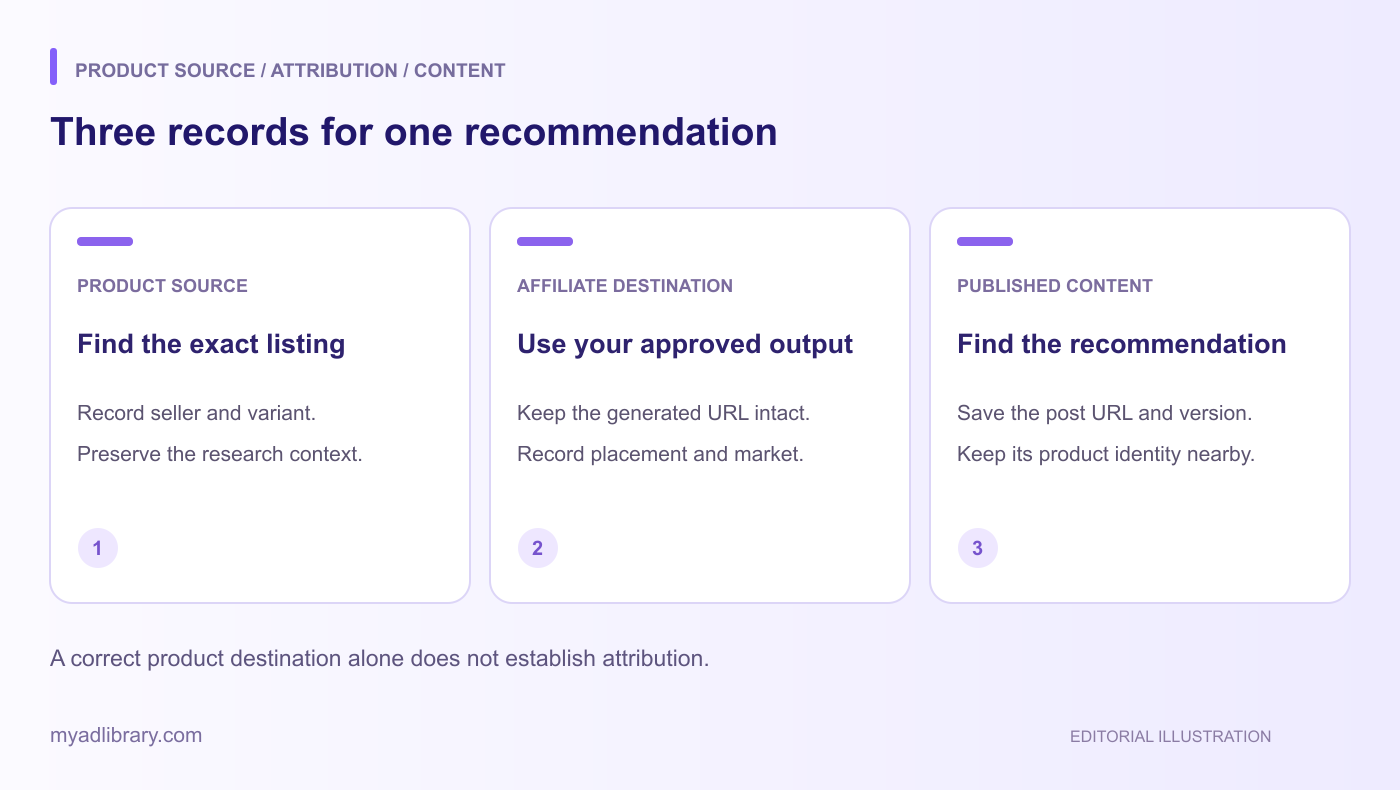
Editorial record model. It is not a Shopee dashboard or a diagram of every attribution rule.
Why appearance is not enough
Two URLs can open a visually identical listing while coming from different sharing workflows. A shortened address may also hide the final destination. Avoid identifying an affiliate link by a guessed domain pattern or by whether the product opens successfully.
For example, Shopee Indonesia's link and commission guidance directs affiliates to a recommended link format and explains that orders must meet validation conditions. Keep the link generated for your account and consult the current local guidance rather than copying another creator's link or a sample URL from a tutorial.
Do not manually add a guessed affiliate ID, remove unfamiliar parameters, or replace the generated address with the final URL after a redirect. If a link needs changing, return to the authorized workflow for your program and retain the replacement in your content record.
A useful record for one recommendation
Create one row per content placement. A spreadsheet or text document is enough; this model does not depend on a particular app.
| Field | Fictional example |
|---|---|
| Content ID | desk-fit-01 |
| Market and program | Your applicable local affiliate program |
| Buyer question | Will this organizer fit beside a laptop? |
| Product identity | Exact listing, seller, and demonstrated variant |
| Product source | Original listing URL retained for reference |
| Affiliate destination | Link generated through your approved account workflow |
| Placement | The specific post or profile destination you intend to use |
| Content URL | Published post address, added when available |
| Offer note | Conditions and date checked in your account |
| Evidence note | Your footage, measurements, or attributed listing details |
Keep the full affiliate link in your private working record, even if your planning board uses a shorter label. Avoid exposing account details in public screenshots of the record.
If your local program supports placement identifiers, follow its documented format and keep the naming consistent. A label such as desk-fit-01 is an example content ID, not a verified SubID syntax for every Shopee market.
Keep research links out of the publishing handoff
A research folder can contain product listings, creator posts, and your own notes. The person publishing the recommendation needs an unambiguous affiliate destination beside the exact content version.
Use separate fields named Product source and Affiliate destination. Do not put both into an unlabeled “link” column. When the affiliate destination is not ready, record that state in your working document rather than quietly substituting the listing URL.
MyAdLibrary can support the creative-reference side of that process. The Shopee Video Downloader displays a public-link input and free-to-try access. A media tool does not create an affiliate relationship or establish that a URL carries your account's attribution. Collection and reuse must also be permitted for the source and program.
For file-level research, see the existing Shopee product-media guide. For the separate question of what belongs in your publishing assets, read our affiliate video permissions guide.
Review the destination separately from attribution
Before a planned post goes live, review whether the link opens the intended product, seller, and market. Compare the shown variant with the item demonstrated in your content. This checks destination accuracy; it is not proof of a commission-bearing transaction.
Treat the following as separate questions:
| Observation | What to investigate next |
|---|---|
| The product opens | Is this the generated affiliate destination intended for this placement? |
| A click appears in reporting | Does the date and placement information match the post? |
| An order appears | What eligibility or validation state does the dashboard show? |
| A commission amount appears | What status and payout conditions apply? |
The Philippine program overview describes dashboard reporting for clicks, orders, and commissions. Use the definitions and statuses shown for your own market rather than treating those measures as interchangeable.
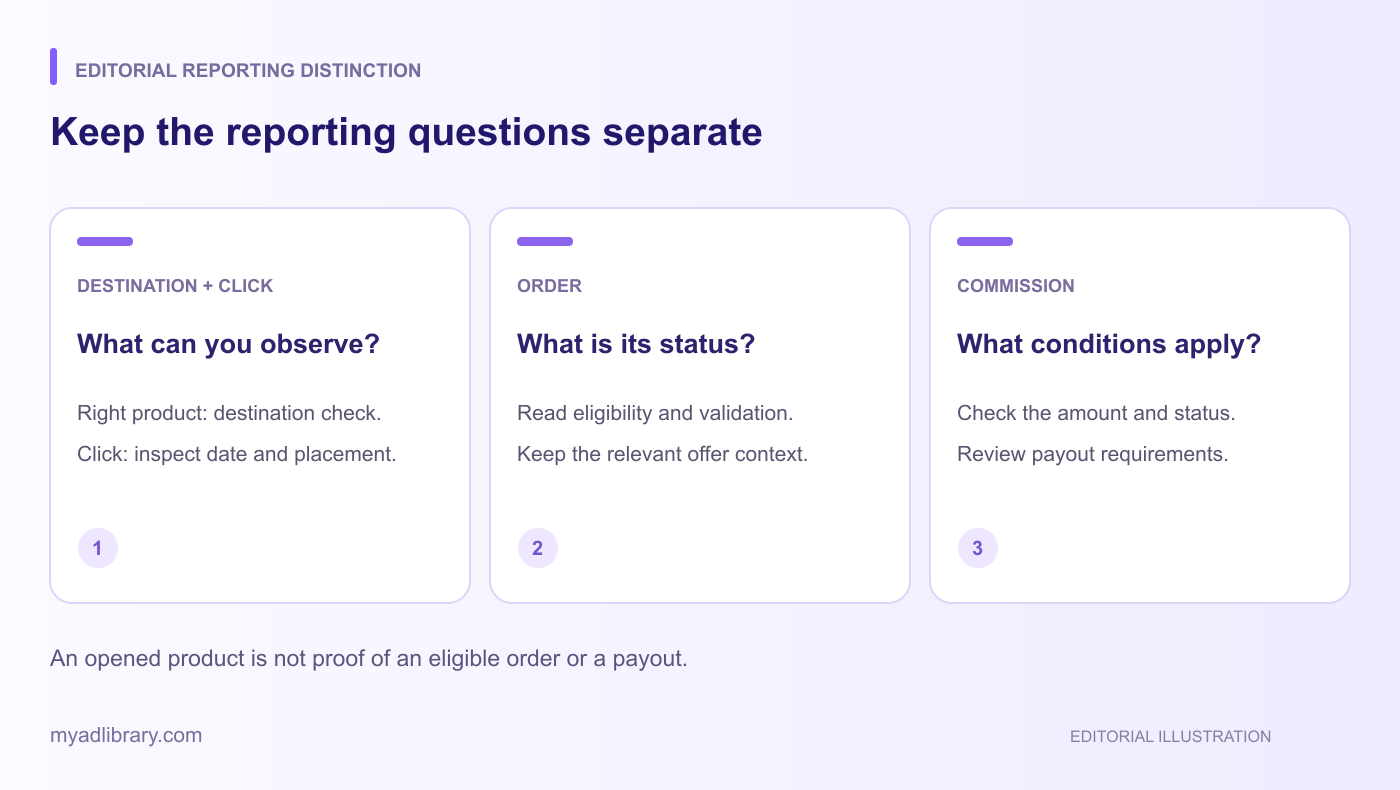
Editorial reporting distinction. It does not promise that a click becomes an eligible order or a payout.
If you are investigating an attribution problem, keep the content URL, generated link, relevant dates, product identity, and observed reporting state together. That gives local support a more useful description than “the link works but I earned nothing.” Do not test commission by making purchases through your own affiliate link.
Keep cross-market planning explicit
A creator publishing in more than one market should record the country with each recommendation. Do not assume that a link or offer generated in one account works under another country's program.
The same applies to channel types. Shopee Indonesia's KomisiXTRA Plus documentation describes channel-specific distinctions for selected products. A general social-post plan should not silently inherit in-app Video or Live assumptions.
For market-specific editorial planning, start with our Philippine starter guide or Indonesia content ideas. Keep the local rules beside your creative plan.
Common questions
Can I use the product URL in my research notes?
Yes, keep the original product source as a reference. That does not answer whether it is the right affiliate destination for a published recommendation.
Does a short Shopee link guarantee affiliate attribution?
Do not infer attribution from length or appearance. Retain the output from your approved affiliate workflow and consult your program's current link guidance.
Does downloading product media create an affiliate link?
No. A media file and a program-generated affiliate destination serve different tasks. Keep both the asset record and the publishing link attached to the correct product.
What is the simplest useful handoff?
Provide the exact product, the approved affiliate destination, the content version, the intended placement, and the date you checked the offer. Understanding a Shopee affiliate link vs a product link becomes much easier when the records are labeled by the job each one performs.